|
|
|
|
|
|
|
|
|
|
|
|
|
|
|
|
||||||||||
|
|
|
|
|
|
|
|
|
|
|
|
|
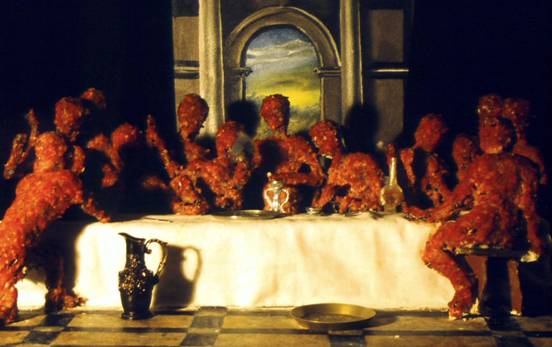
Special FeatureI have decided to incorporate this menu on my website to allow other artists and interested parties some insight in to the complex thinking behind the work I make. Hopefully this will give you some sense of the works importance to me, and my intentions in making the works themselves. Often I hear the same sorts of statements regarding Contemporary Art like; what's that supposed to mean? Or, I could make that? To which I can only reply, so do it. Without an understanding of the complex nature of contemporary art you are not likely to be able to make a work that creates the same impact as many artists do today. Can you come up with that initial idea that at a glance seems so simple? I wonder. Artists today respond to their world very differently to say the Renaissance artists. The world has changed, especially with the development of new technologies. Isn't it time we see that so has the role of the artist and his response to the environment in which he lives? I believe any response and resultant opinion of an artwork is an indication the work is a success? If a dialogue even exists between artist, artwork and audience it's a done deal as far as I'm concerned. What do you think? At approximately four month intervals, I will replace this work with another and offer you similar insight but I will of course respond to a different work. Bear in mind the year in which each work has been made, as it will ultimately have an effect on the complexity of the ideas within the work. My first selection for critical analysis, is a work I produced at Frankston Tafe in 1997; titled 'There is no other God besides me'.
I originally made this work in an effort to control my looming 'Sculptors block'. At the time I was studying 2 nd year Visual Arts in Frankston, and I decided that perhaps the medium of sculpture may be the necessary tool I needed to create further depth in my artistic expression. Like most creative types (at some time or another) I was suffering from a type of visual diary phobia, where I would design, criticise and resolve my artworks in my diary, without actually making anything. This in effect led to my inability to create any work at all. In a sense what I was doing was destroying the possibility of all my ideas without even realising it or them. Looking back perhaps this block came as a result of my perfectionism or the start of a new year in which my periods of creativity were dictated by assessment and also established my love affair with procrastination. However, it may also have simply been my inability to gain control over the new medium with which I was working. Whatever the answer was, with this work I made a deliberate choice to overcome the problems I was having.
I realised I needed to find some way to produce my work that was immediate and short-lived so that it was able to inspire the creation of yet more work. I have always recalled a saying (I don't know whose) that 'you are only as good as your last work'. To me this meant that if I wasn't continually creating, my work was able to become dated and I could not constantly rely upon works I had created years prior as proof of my abilities as an artist. Thus these words motivated me then, and motivate me still to keep working. I decided I needed a medium that would allow for immediate results to build my self esteem with the art of sculpture, and decided I also needed materials that would demand I spend a limited amount of time with them so I would have to produce the works very quickly. This would give me confidence in my abilities, and ensure I was making work on a regular basis. The answers I came up with were that I should use food, or more specifically, mince-meat as my medium, as it adhered to these criteria. I called it 24 hr art; in which I had 24 hours to make and complete the work. I would have just enough time to record the work (photographically) before the meat went off. I decided to use meat, for I had found a series of photographs in an antique store from an abattoir. My first impressions of these photographs resulted in a feeling of masculinity towards notions of 'meat' and ultimately responded to my desires as an artist to work with issues relating to gender and identity. After further examination of the photos, I sensed a visual relationship between the dominating nature and sense of control in the obtainment of meat based on the compositions of the photos, and the similar sense of uncontrollability I felt as a women or piece of meat in the exposure of my gender in mass media. This parallel was drawn visually in my decision to use meat as a tool to represent a controlling gender in the work. I also enjoyed the feminine reference I felt towards meat in the sculpture in terms of women and their general role as chief cook in the home. This provided an irony and tension between gender in the work. The second problem I faced was for what reasons I had to make this work, other than just as a means to fulfil my course requirements and keep making work. My relationship at the time soon gave me the answers.
During this period, I was seeing a fellow student, whose family were practising Catholics. Not being brought up religiously, I found his family's lifestyle new and interesting at the start but then later hypocritical. This became the starting point for the narrative of the work. As an artist, I choose to speak my mind about whomever or whatever I chose in as direct or subliminal means I deem necessary for the expression of that opinion. Often my messages are subtle and usually reference other periods of time, however they are still essentially based in a response to a contemporary issue or event in my life. My primary references are often artistically based, and rely on the metaphorical relationships between gender and those objects or symbols that I feel relate to these genders. Secondary references respond to periods in time or a specific feeling I get from an object by them or in union, which also contribute to the works meaning or dialogue. It is important to me that my work is accessible to a range of individuals, and that the works carry enough depth and artistic skill to nurture this relationship with my audience. For this work I wanted to choose a 'popular', religious, artists image that spoke of not only a controversial moment in history, but of a time during which the role of women was different to their roles today. This image had to be easily recognizable to reflect on the advertising industries saturation of product to consumers. The image also had to respond to my superficial and perhaps naïve opinion and/or understanding of religion during this relationship. The work I created was essentially titled to reflect upon these opinions and my faith in a higher power in general.
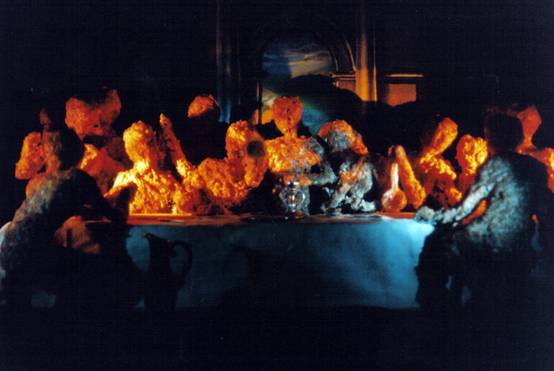
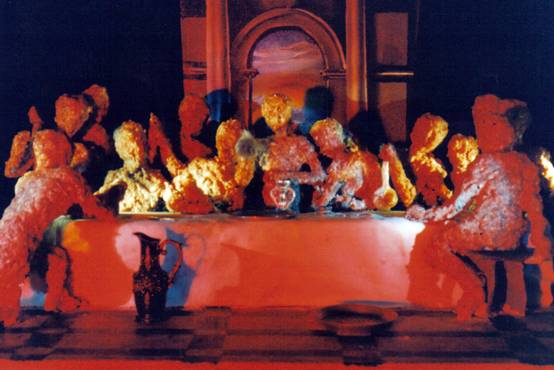
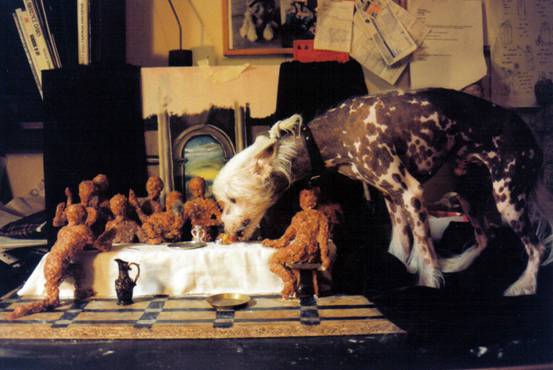
In looking at the work, you will notice a number of important design elements that contribute to the hypocritical feeling I had towards my experience of religion during this relationship. In the background of the image, you will notice a shadow that falls on the backdrop. This shadow falls across the window which allows you to find flaw in the setting. If it was in actual fact a true window, there would be no shadow at all from the figures. The main figure (intended to be Jesus) is actually holding up a piece of fluff I found under the couch. Sarcastically he shouts; 'Look at what I offer you, be amazed at my greatness, for this is what I have to offer'. The representation of this figure also represents my lack of faith regarding religious belief. I have deliberately made Jesus out of the same materials as his disciples, and dare we say to Mary Magdalene, as he in my life is no more or less important than his disciples. There is definitely a deliberate use of humour in the work. Often in visits to my partner's home I would wish his family would just lighten up, have a laugh and just chill out. When visiting his family I would spend hours on the toilet or just sitting in the bathroom pretending to go so I could just breathe freely. This family's rigidity was stifling. At the dinner table I would fantasise about standing up and saying or doing something crazy just to get an animated response, an emotion, anything. In the work this desire for humour is described in Jesus' holding of the piece of fluff. My desire to gain some sort of control over this notion of religion, is evident in the modelling of the figures. I made them, I could also destroy them, and as for my faith; well there is no other God besides me. This sense of control is transcribed in the use of objects in the scene. The vase in the foreground is a salt and pepper shaker, to big for these figures to use. The domination of these figures is also felt in the application of silverware on the table which are actually Babi doll implements from a toy store. Thus we reach the realisation of the feminine elements within the work. A scene created by me not unlike that which I could have made as a girl playing with her dollhouse. As a woman am I trying to establish the same sort of control over my current environment? There is no simple explanation to this work, or to any of my other works post 1996. The more I spend time with my work, the more I see and realise I have responded to. As an artist, it is difficult to interpret all you see within your work. Maturity as an artist and as an individual provides me with new links everyday. I am just as excited to view my works at a later stage, for they always tell me something new. Sometimes I don't know what specific works are really about until much later on. What I do know as an artist is that these works simply have to be made for me to go on. This work was eventually used on the cover of a poetry magazine put out by the Tafe. I also did an image for the back cover in which my dog consumed the sculpture. The words underneath this image stated; 'The Lord provide us'. This second image shared the same sense of humour as the first, yet took a step further to describe the nature of mass consumption and the changing value systems in contemporary society. |